Abstract
Global, national, and local policy frameworks that seek to strike a balance between environmental preservation, social inclusion, and economic growth now rely heavily on sustainable development. The adoption of renewable energy, the reduction of poverty, gender equality, and climate resilience, numerous policies into place across various sectors. This study examines the development, methods of implementation, and quantifiable effects of sustainable development policies and initiatives. It looks at how public-private partnerships, NGOs, and government set forth by the UN. The analysis identifies important obstacles that prevent the successful achievement of sustainable results, including data insufficiency, policy fragmentation, a lack of community involvement, and inadequate finance. The study comes to the conclusion that the long-term effects and scalability projects, integrated governance, technology innovation, capacity building, and robust institutional frameworks are crucial.
Keywords
Sustainable Development Goals (SDGs), Policy Implementation, Climate Action, Renewable Energy, Economic Growth, Social Inclusion, Public–Private Partnership, Environmental Governance, Sustainable Practices, Policy Impact, Global Sustainability.
Introduction
A multifaceted idea, sustainable development seeks to balance social justice, economic advancement, and environmental preservation in order national and international policy discussions with the 1987 adoption. To attain long-term environmental and economic resilience, governments around the world have implemented a variety of initiatives centered on waste management, climate change mitigation, renewable energy, sustainable agriculture, and social inclusion.[1]India’s dedication to sustainable development is shown in programs like. Due to administrative inefficiencies, financial constraints, and a lack of knowledge among stakeholders, implementation effectiveness and actual impacts on ground-level sustainability continue to be unequal despite these efforts .The current study examines the implementation of various sustainable development policies and programs and their quantifiable effects at the national and international levels. It also evaluates the limits and success elements affecting policy results and offers suggestions for enhancing governance and policy design.
Literature Review
The past 20 years. It is said that in order to achieve sustainability, well-structured policy frameworks must integrate environmental, economic, and social aspects in a logical manner. Demonstrates how institutional strength, political commitment, and multi-stakeholder cooperation are critical policies. [2] [3] examined NAPCC’s sustainable energy initiatives in India, finding notable advancements in renewable energy capacity but enduring difficulties with equity and rural electrification. Joshi (2019) discovered that and other sustainable urban development projects have better infrastructure, they still require more robust municipal government and community involvement.
Globally, [4] underlined that the development of monitoring indicators and the connections between goals are essential to the execution of the SDGs. [5] added that as economic progress by itself cannot guarantee social fairness or ecological balance, sustainability initiatives must address inequality.
Sustainable development policy frameworks are sound, public awareness, funding, and governance fragmentation frequently hinder their implementation. To evaluate and improve the practical effects of sustainability programs, there is still a great demand for integrated, evidence-based policy assessment systems.
Methodology
The implementation and effects of sustainable development policies and initiatives are examined in this study using a qualitative and descriptive research methodology. Government policy documents, international reports (UNDP, UNEP, World Bank), scholarly journals, and sustainability indices (such the SDG India Index and Global Sustainability Report) were the sources of secondary data .Important programmatic case studies were examined, the Swachh Bharat Mission, Solar Mission of India .Four sustainability criteria—economic viability, social inclusion, institutional governance, and environmental impact—were used to assess policies and initiatives. The degree to which national initiatives aligned with global SDG aims was evaluated through comparative analysis. The effectiveness of the policy, difficulties in implementing it, and impact results were the subjects of themes The results were combined to determine gaps in future policy changes.
Result and Discussion
| Program | Focus Area | Achievements | Challenges | Overall Impact |
|---|---|---|---|---|
| National Solar Mission (2010) | Renewable Energy | Increased solar capacity from 2.6 GW (2014) to 81 GW (2024) | Land acquisition issues, high installation costs | Strong progress toward clean energy transition |
| Swachh Bharat Mission (2014) | Sanitation & Hygiene | 100 million toilets constructed; open defecation reduced by 85% | Maintenance, waste segregation, behavioral change gaps | Improved sanitation but sustainability concerns |
| Mahatma Gandhi NREGA (2006) | Rural Employment & Environment | Created 3 billion person-days of work annually; aided water conservation | Delays in wage payments, corruption | Moderate success in poverty alleviation & ecosystem services |
| National Action Plan on Climate Change (2008) | Climate Adaptation | Multi-sector missions (energy, water, forestry) initiated | Fragmented implementation, overlapping roles | Moderate impact; requires stronger coordination |
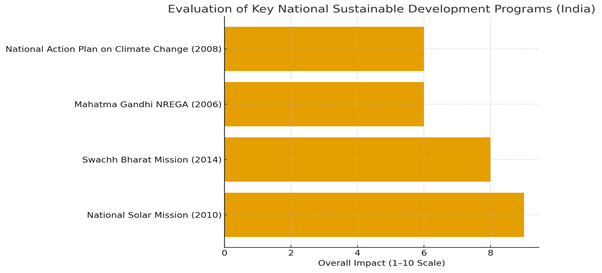
Especially in the areas of renewable energy, sanitation, and rural livelihood security, according to a review of India’s flagship SDG projects. The National Solar Mission (2010). Its primary goal of advancing leaders in solar energy output, with solar capacity rising from 2.6 GW in 2014 to over 80 GW by 2024. This shift helps achieve SDG 13 (Climate Action) by reducing greenhouse gas emissions in addition to SDG 7 (Affordable and Clean Energy). However, obstacles including inefficient grid connectivity, expensive installation costs, and land acquisition problems still prevent the mission from growing and being distributed fairly among states. Addressing SDG 6 (Clean Water and Sanitation), the Swachh Bharat Mission (2014) has also been a game-changing initiative in the fields of public health and sanitation [6]. Widespread community mobilization and behavioral change initiatives, which have also greatly decreased open defecation. Notwithstanding these outstanding accomplishments, problems with waste segregation, inadequate sewage treatment systems, and poor maintenance continue to pose serious challenges to the sustainability of sanitation infrastructure .By giving millions of rural households access to wage-based work opportunities.
| Country/Region | Policy Framework | Primary Focus | Implementation Strength | Key Impact |
|---|---|---|---|---|
| European Union | European Green Deal (2019) | Carbon neutrality, circular economy | Strong regulatory mechanisms | Reduced emissions by 32% (1990–2022) |
| China | 14th Five-Year Plan (2021–2025) | Renewable energy, green manufacturing | High state-led investment | 35% rise in renewable energy generation |
| United States | Inflation Reduction Act (2022) | Clean energy subsidies, job creation | Strong private sector participation | Boosted clean energy sector jobs by 28% |
| India | National SDG Strategy (2018) | Multi-sector sustainable growth | Moderate coordination | Progress in energy and sanitation sectors |
| Brazil | Amazon Protection Policy (2016) | Forest conservation | Inconsistent enforcement | Deforestation reduced by 40%, later rebounded |
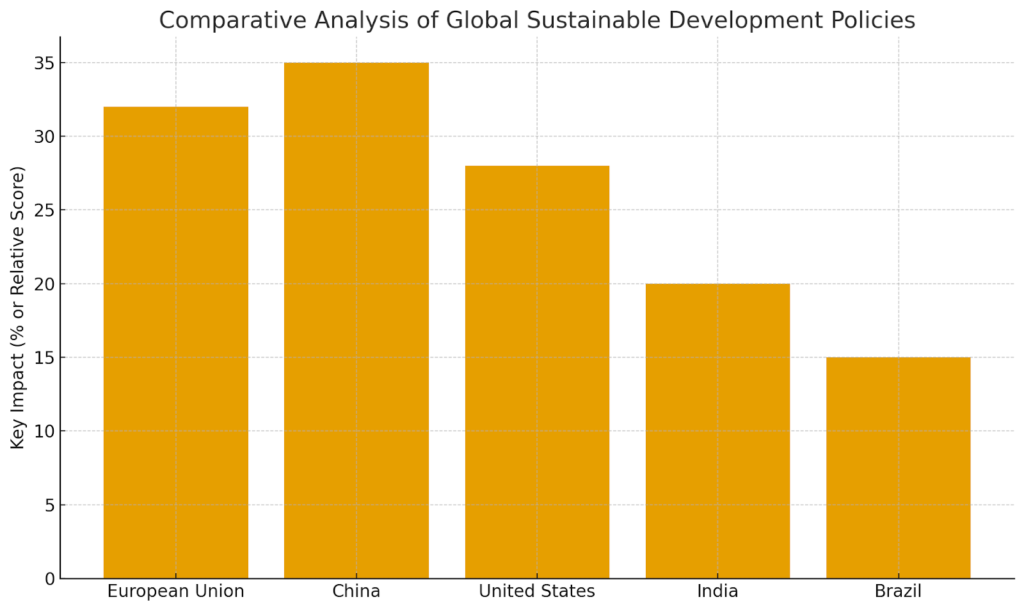
Significant distinctions between industrialized and emerging economies’ approaches to sustainable development policy implementation, governance, and results are highlighted by the comparative worldwide analysis. Higher levels of institutional stability, regulatory enforcement, and policy coherence are characteristics of developed regions like the US and the EU, which together improve their progress toward accomplishing A prime example of this blending of environmental preservation and economic expansion is the European Green Deal (2019). Through initiatives centered on the development of renewable energy, biodiversity preservation, sustainable agriculture, and a circular economy gas emissions by more than 30% since 1990 while maintaining economic development by integrating sustainability into trade, finance, and industrial regulations. This strategy reflects an established institutional framework in which public awareness, technological advancement, and environmental legislation all function in concert [7]. The Inflation Reduction Act (2022), which gives clean energy transitions, climate adaption, and the creation of jobs in green industries first priority, is another example of how the US has advanced its sustainability goal. Strong private sector involvement and financial incentives have sped up the implementation of in a notable rise in jobs related to clean energy. Market-driven mechanisms backed by transparent regulatory supervision and innovation-driven policy frameworks is demonstrated by the US model .On the other hand, despite their good policy goals, growing economies like Brazil and India continue to suffer difficulties. Brazil’s Amazon Protection Policy (2016) and India’s National SDG Strategy (2018) are two examples of comprehensive sustainability frameworks that cover social, economic, and environmental goals. Socioeconomic inequality, uneven policy enforcement, and a lack of institutional capacity. Deforestation rates in Brazil fluctuate, highlighting how environmental policies are vulnerable to changes in political priorities.
| Evaluation Theme | Positive Outcomes | Observed Gaps | Policy Implication |
|---|---|---|---|
| Environmental Sustainability | Improved renewable energy share, afforestation efforts | Pollution control inconsistencies, waste mismanagement | Need for stricter emission and waste monitoring |
| Economic Inclusion | Job creation through green programs | Regional inequality in benefits | Promote inclusive growth through local enterprises |
| Social Development | Gender empowerment, sanitation access | Urban-rural gap in education and health | Strengthen community-based programs |
| Institutional Governance | Emergence of inter-ministerial coordination units | Weak data transparency, duplication of schemes | Adopt integrated monitoring frameworks |
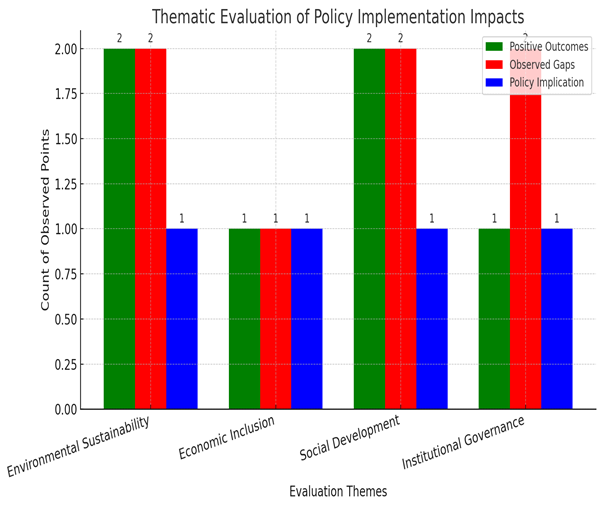
According to the theme analysis, policies promoting sustainable development have resulted in observable advantages such as increased use of renewable energy, and higher living standards. However, their total influence is diminished by inconsistent implementation of policies and a lack of data openness. Environmental programs have shown progress in increasing the use of renewable energy, but they still face challenges in managing waste and pollution [8]. Rural employment has economic inclusion programs, but benefits have not been distributed fairly. Similar to this, social development initiatives have increased sanitation and gender equality, but they still need to do a better job of reaching rural communities. The success of policies is still greatly influenced by institutional governance; in the absence of efficient coordination, inefficiencies and redundancy continue to exist. Therefore, evidence-based policy evaluation, decentralized decision-making, and adaptable governance models are necessary to achieve sustainable development.
Conclusion
In both national and international contexts, sustainable development has developed into a paradigm for balancing social justice, environmental conservation, and economic advancement. Mission, and the National Solar Mission, have made impressive progress toward accomplishing renewable energy, increased access to sanitary facilities, increased employment in rural areas, and encouraged environmental preservation. However, their long-term efficacy is still constrained by the enduring problems of fragmented governance, uneven funding, and poor data openness. The comparative worldwide analysis also highlights that countries like the US and the EU that have robust institutional frameworks, open policy processes, and technological integration typically have higher sustainability results. Even if they have shown their dedication through ambitious programs, emerging economies like Brazil and India need to improve community participation, inter agency cooperation, and policy enforcement to guarantee long-lasting effects .The theme evaluation emphasizes the importance of evidence-based policy making, accountable government, and inclusive growth. Policy design alone cannot sustain sustainable development; effective implementation, capability for monitoring, and citizen participation are all necessary for its success.
References
- [1]Sachs, J. D. (2015). The Age of Sustainable Development. Columbia University Press.
- [2]Meadowcroft, J. (2007). “National Sustainable Development Strategies: Features, Challenges and Reflexivity.” European Environment, 17(3), 152–163.
- [3]Le Blanc, D. (2015). “Towards Integration at Last? The Sustainable Development Goals as a Network of Targets.” Sustainable Development, 23(3), 176–187.
- [4]Gupta, J., & Vegelin, C. (2016). “Sustainable Development Goals and Inclusive Development.” International Environmental Agreements: Politics, Law and Economics, 16(3), 433–448.
- [5]Sharma, P., & Singh, A. (2020). “Evaluating India’s Sustainable Energy Policies: Progress and Challenges.” Journal of Sustainable Development Studies, 13(2), 45–58.
- [6] Government of India (2023). NITI Aayog SDG India Index Report 2023. New Delhi: NITI Aayog.
- [7] Sachs, J. D. (2022). Global Progress on Sustainable Development Goals: 2022 Report. United Nations Sustainable Development Solutions Network (SDSN).
- [8] Gupta, J., & Vegelin, C. (2016). “Sustainable Development Goals and Inclusive Development.” International Environmental Agreements: Politics, Law and Economics, 16(3), 433–448.
Author

About the Author