Image Source: https://www.cainbangalore.com/trademark-objection-reply/
Abstract
Trademark protection forms a fundamental pillar of intellectual property law, as it plays a crucial role in safeguarding brand identity, business reputation, and consumer confidence in the marketplace. In India, trademarks are governed and protected under the Trade Marks Act,1999, and administered by the Office of the Controller General of Patents, Designs and Trade Marks. Despite the existence of a clearly articulated statutory framework, a significant number of trademark applications face objections at the examination stage. These objections commonly arise due to reasons such as absence of inherent distinctiveness, descriptive nature of the mark, resemblance to existing trademarks, or non-compliance with procedural norms. Effectively addressing trademark objections is therefore a critical component of trademark prosecution. Failure to respond adequately or within the prescribed timeframe may result in refusal or abandonment of the application, thereby depriving applicants of statutory protection.
This paper examines the concept and objectives of trademark objections in India, analyzes the statutory grounds on which such objections are raised, and explains the procedural steps involved in responding to them. It also evaluates judicial interpretations and practical difficulties encountered by applicants, and concludes with recommendations aimed at improving the efficiency, transparency, and fairness of the objection-handling mechanism within the Indian trademark system.
Introduction
Intellectual Property Rights have gained substantial significance in the contemporary global economy, particularly within a commercial landscape driven by innovation, branding, and heightened competition. Among the different forms of intellectual property, trademarks hold a unique position as they identify the commercial origin of goods and services and distinguish them from competing offerings. A trademark embodies the goodwill and reputation developed by a business over time and serves as a guarantee of quality for consumers. In India, trademark law has undergone notable development, especially following the enactment of the Trade Marks Act, 1999, which replaced the Trade and Merchandise Marks Act, 1958.
The trademark registration process in India involves several stages, including filing of the application, examination, publication, opposition, and eventual registration. The examination stage assumes particular importance, as it is at this point that the Trademark Examiner evaluates whether the application complies with statutory requirements. Objections are most commonly raised during this stage. It is important to emphasize that an objection does not constitute a final refusal; instead, it represents a preliminary assessment that the applied-for mark does not satisfy certain legal criteria.
Statistics released by the Indian Trademark Registry indicate that a considerable number of applications receive examination reports containing objections. Many applicants, particularly small businesses and first-time filers, find it difficult to comprehend the legal rationale underlying these objections and to respond effectively. Consequently, numerous applications are abandoned or refused due to inadequate replies. This highlights the necessity of understanding the legal framework governing trademark objections and the procedural strategies required to address them successfully. This paper aims to provide a comprehensive analysis of trademark objections in India, focusing on their legal foundation, procedural aspects, and practical implications.
Legal Framework Governing Trademark Objections
The legal basis for trademark objections in India is primarily found in the Trade Marks Act, 1999, read in conjunction with the Trade Marks Rules, 2017. Together, these instruments lay down both the substantive principles and procedural norms governing the registration and refusal of trademarks.
Section 18 of the Act allows any person claiming proprietorship of a trademark to apply for its registration. Once filed, the application is examined by the Registrar of Trademarks under Section 18(4) to assess its conformity with the provisions of the Act and the Rules. If any legal or procedural shortcomings are identified, an Examination Report is issued specifying the objections raised.
Trademark objections are broadly classified into two categories: absolute grounds for refusal and relative grounds for refusal. These classifications are intended to prevent the registration of marks that are either inherently incapable of functioning as trademarks or that conflict with existing trademark rights. While the Registrar possesses discretionary authority in examining applications, such discretion must be exercised within statutory limits and in accordance with the principles of natural justice.
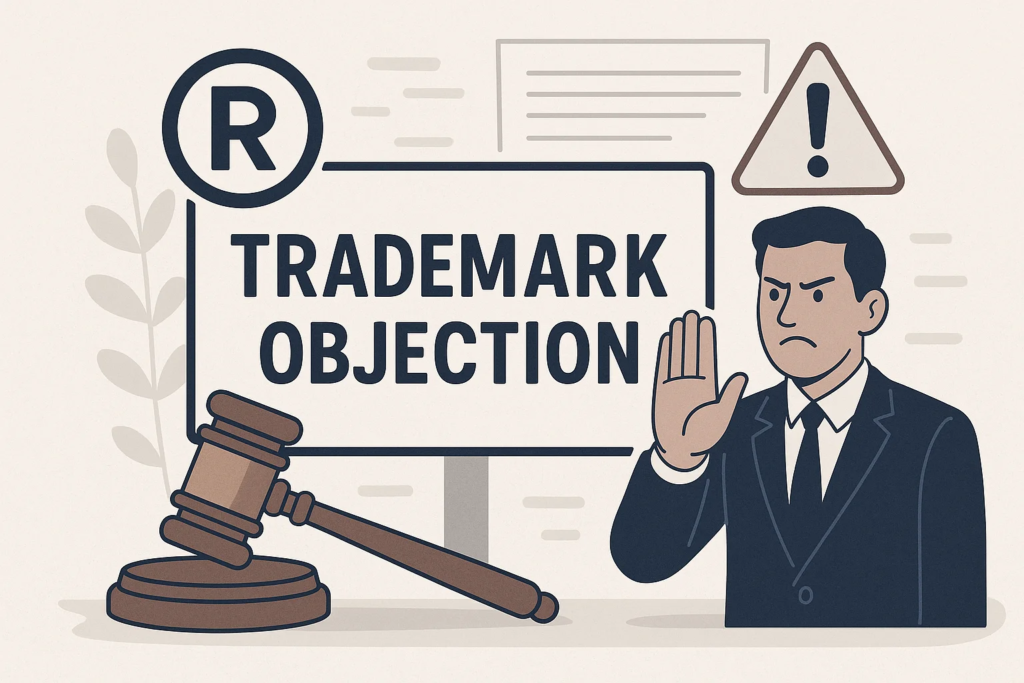
Absolute Grounds for Trademark Objection (Detailed Explanation)
Absolute grounds for refusal are governed by Section 9 of the Trade Marks Act, 1999. These grounds relate to the intrinsic nature of the trademark itself, rather than its relationship with other registered or pending marks. The primary purpose of Section 9 is to ensure that only marks capable of performing the essential function of a trademark are registered, while preventing exclusive rights over common or descriptive terms.
Lack of Distinctiveness
Distinctiveness is a core requirement for trademark protection. Under Section 9(1)(a), a trademark must be capable of distinguishing the goods or services of one entity from those of others. Marks that are generic, commonly used in trade, or part of everyday language generally fail to meet this criterion. For instance, a term that merely identifies the product itself cannot serve to indicate its commercial source.
Indian courts have consistently held that distinctiveness must be assessed from the viewpoint of an average consumer with imperfect recollection. If such a consumer cannot associate the mark exclusively with a single source, the mark is regarded as lacking distinctiveness. This approach ensures that trademark law does not grant monopolies over expressions that competitors may legitimately require in the course of business.
Descriptive Marks and Acquired Distinctiveness
Section 9(1)(b) prohibits the registration of trademarks that directly describe the nature, quality, quantity, intended purpose, or other characteristics of the goods or services. Descriptive marks are inherently weak, as they convey information about the product rather than its origin. As a result, such marks frequently attract objections during examination.
However, trademark law recognizes that descriptive marks may acquire distinctiveness through prolonged, continuous, and exclusive use. This concept of acquired distinctiveness, or secondary meaning, permits registration where consumers have come to associate the mark uniquely with the applicant’s goods or services. To overcome objections on this ground, applicants must submit credible evidence such as sales figures, advertising expenditures, promotional materials, and proof of consumer recognition.
Marks Contrary to Public Interest
Section 9(2) bars the registration of marks that are deceptive, scandalous, obscene, or likely to offend religious sentiments. This provision reflects broader public interest considerations embedded within trademark law. Even a distinctive mark may be refused if its use is likely to mislead consumers or violate social, cultural, or legal norms. Accordingly, absolute grounds for refusal serve both functional and ethical objectives within the trademark regime.
Relative Grounds for Trademark Objection (Detailed Explanation)
Relative grounds for refusal are set out under Section 11 of the Trade Marks Act, 1999. Unlike absolute grounds, these objections arise due to conflicts between the applied-for trademark and existing trademark rights. The principal aim of Section 11 is to protect prior rights and prevent consumer confusion.
Likelihood of Confusion and Deceptive Similarity
Section 11(1) prohibits the registration of a trademark that is identical or similar to an earlier mark where such similarity is likely to cause confusion among consumers. The applicable test is one of probability rather than certainty. Even a likelihood of association with an earlier trademark may be sufficient to sustain an objection.
In determining similarity, the Registrar considers various factors, including visual appearance, phonetic resemblance, conceptual similarity, and the overall commercial impression of the marks. Additional considerations include the nature of the goods or services, the class of consumers, and the channels of trade. This holistic assessment ensures that consumer perception remains central to trademark protection.
Earlier Trademarks and Pending Applications
Relative objections may arise not only on the basis of registered trademarks but also with reference to earlier pending applications. Therefore, a conflicting mark need not be registered to form the basis of an objection. This approach upholds the principle of priority and prevents the concurrent registration of similar marks.
Protection of Well-Known Trademarks
Section 11(2) affords enhanced protection to well-known trademarks, even with respect to dissimilar goods or services. The underlying rationale is to prevent dilution, unfair advantage, and damage to the reputation of well-known brands. Objections raised on this ground seek to preserve the commercial value and distinctive identity associated with such trademarks.
Procedure for Handling Trademark Objections
Reply to Examination Report
Upon receipt of the Examination Report, the applicant must file a response within thirty days. The reply should address each objection separately and be supported by legal reasoning, factual explanations, and relevant judicial precedents. A well-drafted response demonstrates a logical application of law to the specific facts of the case.
Show Cause Hearing
If the Examiner remains dissatisfied with the written response, a show cause hearing may be scheduled. At this stage, the applicant or their authorized representative is given an opportunity to present oral submissions and clarify unresolved issues. The hearing plays a critical role in persuading the Registrar regarding the registrability of the mark.
Decision of the Registrar
After considering the written submissions and oral arguments, the Registrar may either accept the application for publication or refuse it by issuing a reasoned order. An applicant aggrieved by such refusal may file an appeal before the High Court under Section 91 of the Act.

Judicial Approach to Trademark Objections
Indian courts have played a significant role in shaping the principles governing trademark objections. Judicial pronouncements have emphasized that objections should not be raised mechanically and must be supported by clear and reasoned analysis. Courts have also reiterated that descriptive marks deserve protection only upon adequate proof of acquired distinctiveness.
Moreover, the judiciary has stressed the need for consistency and transparency in examination practices. By subjecting administrative decisions to judicial review, courts ensure that the Registrar’s powers are exercised fairly and within legal boundaries. Judicial intervention has also reinforced the balance between proprietary rights and public interest, preventing unwarranted monopolization of commonly used terms while protecting legitimate brand identity.
Practical Challenges Faced by Applicants
Despite a comprehensive legal framework, applicants encounter several practical difficulties when dealing with trademark objections. A recurring concern is the issuance of vague or overlapping objections without sufficient reasoning, which places an additional interpretative burden on applicants.
Procedural delays further complicate the process, as hearings and decisions often exceed prescribed timelines. Inconsistencies in examination practices across different Trademark Registry offices also create uncertainty and unpredictability. Small businesses and individual applicants are particularly affected due to limited legal awareness and financial resources. The use of complex legal terminology in examination reports frequently exacerbates these challenges, increasing the risk of abandonment.
Recommendations for Improvement
To enhance the effectiveness of the objection-handling process, several reforms may be considered. The introduction of standardized examination guidelines would promote uniform application of legal principles. Regular training programs for Examiners could ensure familiarity with judicial precedents and international best practices. Greater digital transparency in examination reports and hearing records would further strengthen accountability. Applicants should also be encouraged to conduct thorough pre-filing searches to minimize avoidable objections.
Additionally, increased emphasis on applicant education through awareness programs, workshops, and simplified guidance materials would empower applicants to respond more effectively to objections and reduce procedural errors.
Conclusion
Trademark objections play a crucial role in maintaining the integrity of the trademark register and preventing unlawful monopolization of common or conflicting marks. Although the Trade Marks Act, 1999 provides a detailed framework for addressing objections, practical challenges continue to affect the system’s efficiency. Effective handling of trademark objections requires a sound understanding of legal principles, procedural diligence, and strategic presentation of evidence.
By implementing reforms focused on transparency, consistency, and capacity building, India can strengthen its trademark administration and improve intellectual property protection. A predictable and efficient objection-handling mechanism builds stakeholder confidence and encourages broader participation in the formal trademark system, thereby supporting innovation, entrepreneurship, and fair competition.
Author

About the Author