Image Source: https://blog.ipleaders.in/wp-content/uploads/2021/06/Environmental-Laws.jpg
Introduction
Wetlands are a significant reservoir of carbon in the global carbon cycle. However, these ecosystems are threatened by climate change, such as higher temperatures and increased flooding. These changes can trigger the release of more carbon, mainly as methane, into the atmosphere. Wetland ecosystems exist from polar regions to the tropics, across nations and climates, including high-altitude and arid areas. The IPCC’s Fifth Assessment Report states that wetlands account for about 20% of global methane emissions. Tropical wetlands react very differently from temperate wetlands due to variations in temperature, hydroperiod, vegetation mix, soil type (organic or mineral), and nutrient availability. According to Armentano and Verhoeven (1990), tropical wetlands are mineral-soil wetlands that do not store much organic matter due to their frequent wet-dry cycles. Due to its expansive geography, diverse topography, and ever-changing climate, India hosts a wide array of both interior and coastal wetlands. Wetlands comprise 4.7% of India’s total geographic area and are found throughout the country, from the Himalayas to the Deccan Plateau (Bassi et al., 2014). Dominated by water, wetland ecosystems possess distinct characteristics that combine features of both terrestrial and aquatic environments. These unique habitats foster diverse flora and fauna while serving various ecological, climatic, and societal functions.
India has 75 Ramsar sites (wetlands designated as of international importance under the Ramsar Convention). Among these, the Vembanad-Kol Wetland system in Kerala has been selected as a Ramsar site since 2002. This wetland, integral to India’s longest lake, has been a lifeline for local communities, providing essential resources such as crops, fish, and fodder. Rice production in the districts of Thrissur and Malappuram depends heavily on the 13,500-hectare Kole wetlands. Beyond its role in sustenance, the Vembanad-Kol plays a crucial hydrological role, shielding major cities like Cochin and Ernakulam from floods and ensuring water supply for agriculture in the Kuttanad area. Moreover, in the winter season, it hosts the country’s third-largest waterfowl population. This recognition underscores its ecological and societal importance.
However, since the 1970s, the Vembanad-Kole system has lost over 35% of its wetland area, indicative of the cumulative effects of human activities (ATREE, 2021). The degradation has increased the likelihood of disasters such as flooding and saline intrusion, underscoring the urgent need for institutional and legal action. The entire spectrum of ecosystem services and biodiversity values in regional development planning has various negative ecological and socioeconomic implications. Rapid urbanisation invaded its rich, luxuriant natural ecosystems, while industrialisation not only caused pollution but also prevented regeneration.
Before the middle of the 19th century, there was minimal anthropogenic pressure on the wetland complex, but it has since become a centre of backwater tourism. Increasing anthropogenic activities have generated nutrient-rich wastewater that is discharged into wetlands via surface runoff. Consequently, low O2 content and sediment accumulation can accelerate GHG emissions. Eventually, wetlands are natural sources that generally release GHGs in small amounts, but pollution and excessive nutrient loading can accelerate their release. Emitting from a wide range of natural and human-driven sources, methane is the second-largest contributor to global warming, after carbon dioxide.
Legal Framework for Wetland Conservation in India
International, national, and state policies guide India’s wetland protection. Globally, the UN Agenda 2030 emphasises environmental protection through SDG 15, “Life on Land,” which aims to conserve ecosystems and forests, combat desertification, and halt land degradation and biodiversity loss.
The Ramsar Convention, established on February 2nd, 1971, is a global treaty that guides the responsible management and protection of wetlands and their resources, and sets straightforward directives. The Ramsar Convention defines wetlands as: “areas of marsh, fen, peatland or water, whether natural or artificial, permanent or temporary, with water that is static or flowing, fresh, brackish or salt, including areas of marine water the depth of which at low tide does not exceed six meters”. The Vembanad-Kole wetland was designated a Ramsar site in 2002, making it part of the international network of wetlands of global importance.
Multiple laws support India’s wetland conservation. The Environment (Protection) Act, 1986 (EPA), is the primary law that allows the government to issue rules for environmental protection. The Wetlands (Conservation and Management) Rules, 2017, replace the 2010 version and require states to identify, notify, regulate activities, and establish Authorities. The Water Act, 1974, addresses pollution from industries and municipalities, while the Biological Diversity Act, 2002, fosters conservation via local Biodiversity Management Committees (BMCs). The Indian Forest Act, 1927, and the Wildlife Protection Act, 1972, indirectly protect wetlands within forests or sanctuaries. Together, these laws create a comprehensive framework, though effectiveness depends on coordination between central and state agencies —an ongoing challenge, notably in the Kerala system.
These laws establish a comprehensive legal framework, but their success depends on effective coordination between central and state agencies —a challenge that is especially evident in Kerala.

Kerala’s Legal and Institutional Mechanisms
Kerala is among the few Indian states with specific laws for wetland conservation, such as the Kerala Conservation of Paddy Land and Wetland Act, 2008. This law bans the reclamation, conversion, or misuse of paddy lands and wetlands and empowers District-Level Monitoring Committees to identify violations and restore illegally altered areas. Nonetheless, the lack of a clear definition of “public purpose” and inadequate enforcement allow many violations to go unnoticed. The State Wetland Authority of Kerala (SWAK), created under the Wetlands (Conservation and Management) Rules, 2017, is tasked with identifying wetlands, drafting management plans, and ensuring compliance. Still, staffing shortages, limited budgets, and poor interdepartmental coordination hamper its effectiveness. Additional policy initiatives include the Kerala State Action Plan on Climate Change (2014), which highlights wetlands as natural climate buffers; the Haritha Kerala Mission (2017), focusing on waste, water, and ecological management; and provisions in the Local Self-Government Acts that empower panchayats to oversee common lands and water bodies. Despite this broad policy framework, inconsistent implementation and ongoing illegal encroachments and wetland degradation pose persistent governance challenges. State. Wetland conservation in Kerala involves the government, NGOs, and civil groups. From 1985 to 2012, India’s NWCP, with states, aimed to protect wetlands and Ramsar sites, develop policies, fund efforts, monitor programs, and inventory wetlands (GOK, 2019).
Case Study: The Vembanad-Kole Wetlands
Vembanad Lake (9° 34′ 60 N, 76° 25′ 0 E) is situated on the west coast of India, and it holds the distinction of being the largest brackish humid tropical wetland in the region. It spans a length of 96 km and covers a substantial surface area of 1512 km². This wetland, due to its significant ecological and socio-economic value, has been designated as a UNESCO-protected wetland region under the Ramsar Convention of 1971 since 2002, denoting its international importance. Vembanad Lake spans across three districts: Alappuzha, Kottayam, and Ernakulam. It is fed by ten rivers, including the six major rivers of central Kerala: Achenkovil, Manimala, Meenachil, Muvattupuzha, Pamba, and Periyar. The wetland complex consists of the Kuttanad and Kol River floodplains in the south and north, respectively, and the Vembanad estuary, which is surrounded by river estuaries. Vembanad estuary, often known as the backwaters, is a distinctive ecosystem that plays a crucial role in Kerala’s geography, history, culture, environment, and socioeconomic growth.
Vembanad Lake is unique in terms of its hydrological function, biodiversity, land use, flora, and fauna. During the winter months, it supports the third-largest waterfowl population in India and is renowned for its clams. The lake is divided between a saltwater-dominant northern zone and a freshwater-dominant southern zone by a bund at Thanneermukkom, where the lake is at its narrowest. The bund was built in 1975 to prevent saline water intrusion and encourage double paddy planting across the area’s 55,000 acres of low-lying fields (Padasekharams). A slipway was built at Thottappally in 1955 to facilitate the quick drainage of water from the lake to the Arabian Sea, preventing floods during the monsoon season. The eastern half of the lake has been reclaimed for irrigation, and bunds have been built in the south, where the lake is at its widest. Flood protection for the thickly populated coastal areas of three districts of Kerala is considered a significant benefit of this ecosystem. Groundwater recharge helps to supply healthy water for the region, and the value of the system for local transport of people and trade is considerable.
Kuttanadu, a marshy delta in the southern half of the lake, was created by the confluence of four river networks—the Pampa, Manimala, Achankoil, and Meenachil—and the backwaters in and around Vembanad Lake. The majority of rice cultivation in the region is done below sea level. As a result, the farming system there is attracting attention worldwide due to sea-level rise driven by climate change. Large sections of the enormous estuary are submerged below sea level up to a depth of around 2.5 metres, where they remain wet for the majority of the year and are vulnerable to flooding and inundation during the monsoon season, as well as saline water intrusion during the summer. Lowland agriculture is primarily centred in Kuttanad and Kol areas, and brackishwater aquaculture is also practised in the marshes of Ernakulam and Alappuzha districts. After harvest, rice fields are fitted with locally built gates that allow water from high tides to be contained inside the fields. The name of this locally developed technology is pokkali. Based on geomorphology, soils, and salinity intrusion, the Kuttanad region is split into six agronomic zones: Upper Kuttanad, Lower Kuttanad, North Kuttanad, Kayal Lands, Vaikkom Kari, and Purakkad Kari. Kuttanad farming was named a Globally Important Agriculture Heritage System (GIAHS) by the United Nations Food and Agriculture Organisation (WISA, 2013).
Various Threats to the VKW
Wetland processes are directly and indirectly significantly affected by changes in land use and land cover. Numerous changes have been made to VKW, most notably reclamation for agriculture. The backwaters were reclaimed for agriculture, aquaculture, fishing harbours, and enterprises over a 237 km2 area between 1834 and 1983 (Gopalan et al., 1983). In the regions of Kuttanad, Kaipad, and Pokkali, the backwater parts of the Vembanad estuary have been reclaimed for agriculture. In this area, punja, virupu, and mundakan are the three main crops grown. The brackishwater marsh pokkali farming system is exclusive to the area. However, agricultural production has declined over the last three decades, particularly for the second crop. This increases the risk of flooding during the monsoon.
History shows that human interaction negatively affects this ecosystem in various ways, and the Kuttanad development scheme is one of them. The construction of the Thottappally spillway, Thanneermukkom bund, and Alappuzha Changanessery Road has altered this natural ecosystem due to improper implementation and poor management (Sreejith, 2013). The state of this vital environment has worsened due to increased land reclamation, encroachment, and pollution caused by population growth, urbanisation, and industrialisation along the Vembanad shoreline. Unsustainable farming operations, such as the extensive use of pesticides and fertilisers, have led to variations in nutrient availability and the growth of hazardous algal blooms, which can have catastrophic effects on aquatic life.
Over the years, Vembanad Lake has experienced a crucial decline in its water storage capacity. In 1900, it could hold 2617.5 million cubic meters of water, but by 2020, this capacity had dwindled to 387.87 million cubic meters, an 85.3% decrease. One of the key factors contributing to this reduction is the extensive mining of river sand and gravel in the Vembanad catchment area. This mining activity is particularly intensive in the alluvial stretches of the main river channels. According to estimates provided by Padmalal et al. (2008), the seven rivers that flow into the Vembanad estuary collectively yield approximately 12.13 million tonnes of sand and gravel annually. Consequently, this ongoing sand mining has had a detrimental impact on the in-stream fish population in these rivers.
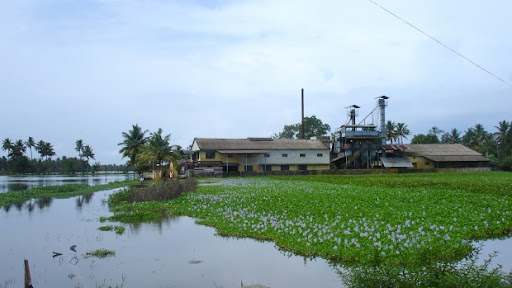
Sewage and industrial effluents from Kochi and nearby urban centres further degrade water quality, while sand mining and dredging activities have significantly altered the region’s natural hydrology. The rapid spread of invasive aquatic weeds, such as Eichhornia crassipes (water hyacinth), has also impeded water flow and reduced biodiversity (ATREE, 2020; KSDMA, 2022).
The presence of microplastics in the lake is significant, as clams and fish are primary sources of protein for local inhabitants. This poses a grave threat of contaminating the lake’s food web, endangering both the ecosystem and the health of people who rely on it (Sruthy & Ramasamy, 2017). Vembanad-Kol’s biodiversity is found inside a heavily altered and fragmented landscape. The reclamation of wetlands for agricultural use, the rapid expansion of tourism infrastructure, and the expansion of settlement areas have all harmed ecosystems. To ensure that the biological assets of the Vembanad-Kol backwaters are not lost during increasing economic development, the few species-rich pockets, such as Pathiramanal Islands and Kumarokom, need to be urgently protected (WISA, 2013).
Challenges for Conservation
The conservation efforts for the Vembanad wetlands are governed by a complex and somewhat fragmented legal framework, shaped by several key environmental laws. The Environment (Protection) Act of 1986 provides the primary basis for pollution control and environmental protection, resulting in the Coastal Regulation Zone (CRZ) Notifications of 1991 and 2011, which are crucial for managing the coastal and backwater areas of Vembanad. Additionally, the Water (Prevention and Control of Pollution) Act of 1974 empowers the Central and State Pollution Control Boards to regulate water pollution, with local bodies playing a limited role. The Kerala Panchayat Raj Act and the Kerala Municipalities Act of 1994 support local self-governments in overseeing waste management, protection of water sources, and pollution control.
The Kerala Protection of River Banks and Regulation of Removal of Sand Act, 2001, aims to preserve river ecosystems by regulating sand mining and maintaining riverbank stability, while the Wetlands (Conservation and Management) Rules of 2017 mandate the identification, notification, and protection of wetlands through State Wetland Authorities. Despite these laws, enforcement remains weak due to limited capacity, lack of political support, and minimal community involvement, particularly among farmers and fishers. Governance is further hampered by the highly fragmented system of multiple departments and agencies operating independently, which impairs coordination and accelerates ecosystem degradation. There is little comprehensive assessment of development impacts, and private projects often prioritise profits over environmental responsibilities, resulting in violations of environmental laws.
Overall, Kerala’s commitment to sustainable development suffers from weak enforcement, with government departments often being major violators and oversight systems being ineffective. Although some environmentally friendly practices, such as organic farming, exist, incentives are scarce, and economic interests tend to dominate, leading to a laissez-faire approach that leaves the ecosystem largely unprotected. Rapid urban expansion driven by tourism and real estate development around Kochi and Thrissur further pressures fragile wetlands. Judicial interventions, such as the Kerala High Court’s rulings in 2018 and 2019, have mandated stricter enforcement and boundary demarcation, while civil society organisations like ATREE, the Vembanad Wetland Conservation Forum, and the Kole Farmers’ Societies actively promote sustainable management and community engagement. Nonetheless, their impact remains limited due to systemic weaknesses and insufficient follow-up on legal measures, highlighting the urgent need for integrated, well-enforced policies to conserve and sustainably manage the Vembanad wetlands effectively.
Conclusion
The combined conclusion emphasizes that the preservation and sustainable management of the Vembanad ecosystem hinge on establishing a comprehensive, participatory governance framework that integrates legal, scientific, and community-based approaches. It advocates for creating a dedicated Joint Committee of Panchayats (SAVED) to oversee the ecosystem’s social mobilization, eco-restoration, and sustainable development, thereby addressing current governance gaps. Supporting this structure with a science and technology advisory committee will ensure decision-making is grounded in evidence, enhancing the effectiveness of conservation efforts. Additionally, implementing sustainable financing mechanisms—such as government allocations, tourism and industrial taxes, and a dedicated Vembanad Ecosystem Restoration and Development Fund—will secure long-term resources for preservation activities. Engaging local communities, including farmers, fishers, women’s groups, and other stakeholders, is crucial for fostering accountability, transparency, and ownership. Transitioning from a laissez-faire approach to an integrated, science-based, and community-driven model is essential to counteract environmental decline, protect biodiversity, support livelihoods, and ensure resilience against climate challenges. Ultimately, safeguarding the Vembanad wetlands is not merely a legal obligation but a vital ecological and socio-economic necessity for Kerala’s sustainable future.
References
- Arneth, A., Harrison, S. P., Zaehle, S., Tsigaridis, K., Menon, S., Bartlein, P. J., … & Vesala, T. (2010). Terrestrial biogeochemical feedbacks in the climate system. Nature Geoscience, 3(8), 525–532.
- Asha, C. V., Retina, I. C., Suson, P. S., & Bijoy Nandan, S. (2016). Ecosystem analysis of the degrading Vembanad wetland ecosystem, the largest Ramsar site on the South West Coast of India—Measures for its sustainable management. Regional Studies in Marine Science, 8, 408-421.
- Ashoka Trust for Research in Ecology and the Environment (ATREE). (2021). Vembanad-Kole Wetland Health Report. Bengaluru: ATREE.
- Bassi, N., Kumar, M. D., Sharma, A., & Pardha-Saradhi, P. (2014). Status of wetlands in India: A review of extent, ecosystem benefits, threats and management strategies. Journal of Hydrology: Regional Studies, 2, 1–19.
- Gadgil, M. (2011). Western Ghats Ecology Expert Panel Report. Ministry of Environment and Forests, Government of India.
- Gopalan, U. K., Vengayil, D. T., Udayavarma, V. P., & Krishnankutty, M. (1983). The shrinking backwaters of Kerala. Journal of the Marine Biological Association of India, 25(1), 131–141.
- Government of India. (2017). Wetlands (Conservation and Management) Rules, 2017. Ministry of Environment, Forest and Climate Change.
- Government of Kerala. (2008). Kerala Conservation of Paddy Land and Wetland Act. Kerala Gazette. 9. GoK. (2019). State Wetland Authority Kerala (SWAK). Directorate of Environment and Climate Change, Government of Kerala.
- Kerala State Disaster Management Authority (KSDMA). (2022). Kerala State Disaster Management Plan: Floods and Wetlands Section. Government of Kerala.
- Lake, A., Mohamed, K. S., Jheel, K., Kumar, R., & Ambastha, K. Natural capital of wetlands. 12. Menon, A., & Nair, K. (2021). Wetlands and environmental law in Kerala: Challenges in implementation. Journal of Environmental Policy Studies, 18(3), 215–229.
- Padmalal, D., Maya, K., Sreebha, S., & Sreeja, R. (2008). Environmental ef ects of river sand mining: A case from the river catchments of Vembanad Lake, southwest coast of India. Environmental Geology, 54(4), 879–889.
- People’s Union for Civil Liberties v. State of Kerala, Kerala High Court (2018).
- Prasanna, C. K., Vannadil, P. K., & Ayyappan, V. P. (2020). Wetland conservation and sustainable development in Kerala, India. In Life on Land (pp. 1–12). Springer International Publishing. 16. Ramsar Convention Secretariat. (2016). An introduction to the Ramsar Convention on Wetlands. Ramsar Secretariat, Gland, Switzerland.
- Sreejith, K. A. (2013). Human impact on the Kuttanad wetland ecosystem overview. International Journal of Science and Technology, 2(4), 679–670.
- Sruthy, S., & Ramasamy, E. V. (2017). Microplastic pollution in Vembanad Lake, Kerala, India: The first report of microplastics in lake and estuarine sediments in India. Environmental Pollution, 222, 315–322. 19. The Hindu. (2023, March 4). Encroachments continue to threaten Vembanad Lake—The Hindu. 20. Vembanad Lake Protection Forum v. State of Kerala, Kerala High Court (2019).
Author

About the Author